

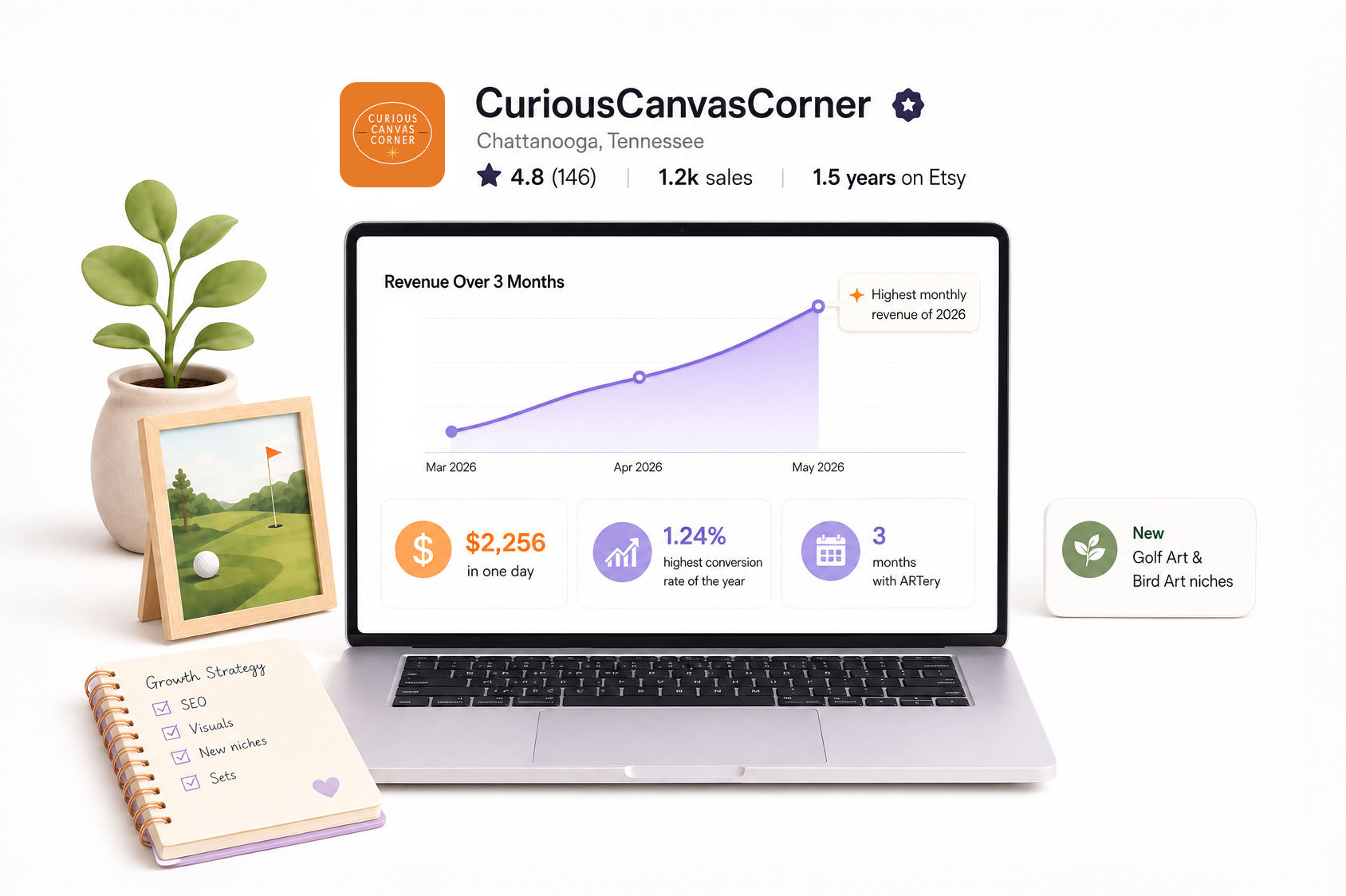
How a coordinated Etsy SEO and creative optimization strategy helped CuriousCanvasCorner achieve its highest monthly revenue of 2026, generate a record-breaking $2,256in a single day, and reach its highest conversion rate of the year at 1.24%.
Highest monthly revenue of 2026
$2.2K revenue generated in one day
1.24% highest conversion rate of the year
New Golf Art and Bird Art niches successfully developed

Client Overview - A Distinctive Art Brand Ready for a More Structured Growth
CuriousCanvasCorner is an Etsy art shop specializing in vintage-inspired, made-to-order wall prints with a soft, timeless, and collected aesthetic.
The shop’s product range combines nostalgic visual storytelling with modern home décor applications. Its catalog includes golf wall art, bird prints, coastal and mermaid artwork, floral designs, dark academia prints, and sentimental pieces.
The brand already had strong creative foundations. The artwork had a recognizable visual identity, while the products were suitable for a wide range of interiors, gifting occasions, and buyer profiles.
The shop’s public presentation also demonstrated growing customer trust. CuriousCanvasCorner had achieved Star Seller status, ~1,200 sales, a 4.8 average rating, and more than 140 customer reviews.

However, creative quality alone was not enough to unlock the shop’s full commercial potential.
When the client entered with our SEO Success Program, the primary objective was to build a more scalable growth system by combining:
- Search-driven product development
- Listing-level Etsy SEO
- Strategic expansion into new niches
After 2 months, CuriousCanvasCorner subscribed to our Visual Marketing program, where we focused on:
- Stronger listing visuals
- Single-product and product-set positioning
- Improved alignment between buyer intent and creative presentation
Rather than focusing only on improving the visibility of the existing catalog, we identified an opportunity to develop entirely new revenue channels within the shop.
The project became a collaboration between our SEO and Creative departments.
The SEO team identified where demand existed, how buyers were searching, and which keyword clusters offered realistic growth opportunities. The Creative team then transformed these insights into products and listing visuals designed to attract clicks and convert traffic.
Within three months into the program, this combined approach helped CuriousCanvasCorner achieve its highest monthly revenue of 2026, its highest single-day revenue, and its strongest conversion rate of the year.
Challenges & Key Findings
Before implementing changes, we conducted a complete review of the shop’s SEO structure, product positioning, visual presentation, and category coverage.
The audit included listing titles and tags, keyword depth, niche concentration, product-development opportunities, internal keyword competition, conversion performance, and the alignment between listing visuals and targeted search terms.
Although CuriousCanvasCorner already had a strong artistic identity, the shop lacked a clear system for turning creative ideas into search-driven product opportunities.
Product development was mainly guided by visual potential rather than keyword demand, competition, and buyer intent. This made it difficult to identify which niches had the strongest commercial potential and how each new design should be positioned in Etsy search.
Our goal was to connect SEO research directly with product development.
1) New Niche Opportunities
During the research phase, we identified several promising growth categories:
- Famous Golf wall art courses
- Bird and nature-inspired wall art
- Sports-related art designs
Golf art provided access to highly targeted décor and gifting searches, including gifts for golfers, Father’s Day, retirement gifts, office décor, man cave art, clubhouse decoration, and famous golf-course prints.
Bird art opened opportunities across cottagecore, farmhouse, nursery, woodland, coastal, botanical, and bird-lover gift searches.
Both categories were valuable because they combined home décor intent with emotional and gift-based buying intent.
2) Single Prints and Sets
Another important opportunity was the introduction of both individual prints and coordinated art sets.
Single prints appealed to customers looking for a lower-priced purchase, one specific design, or an addition to an existing gallery wall.
Sets appealed to buyers searching for a complete decorating solution, coordinated artwork, or a higher-value gift.
By offering the same design direction in multiple formats, the shop could reach more buyers, increase keyword coverage, and create stronger average-order-value opportunities.
3) Search Visibility and Visual Conversion
We also found that SEO and listing visuals needed to work more closely together.
Optimized titles and tags can increase impressions, but the first listing image determines whether a customer clicks.
The shop’s thumbnails and mockups needed to communicate immediately:
- The style of the artwork
- Whether the listing included one print or a set
- How the artwork would look in a real interior
- Which room or customer the product was designed for
- The value of purchasing a coordinated collection
This was where collaboration between our SEO and Creative departments became essential.
The SEO team identified the strongest niches, keywords, and buyer intents, while the Creative team developed products and visuals that matched those opportunities.
What we found
Golf art offered significantly more keyword depth than the broad phrase “golf wall art.”
Listings could be positioned through specific courses, room use, gifting occasions, product format, and customer type. This included searches related to famous golf courses, golfer gifts, office décor, man caves, retirement gifts, and sets of golf prints.
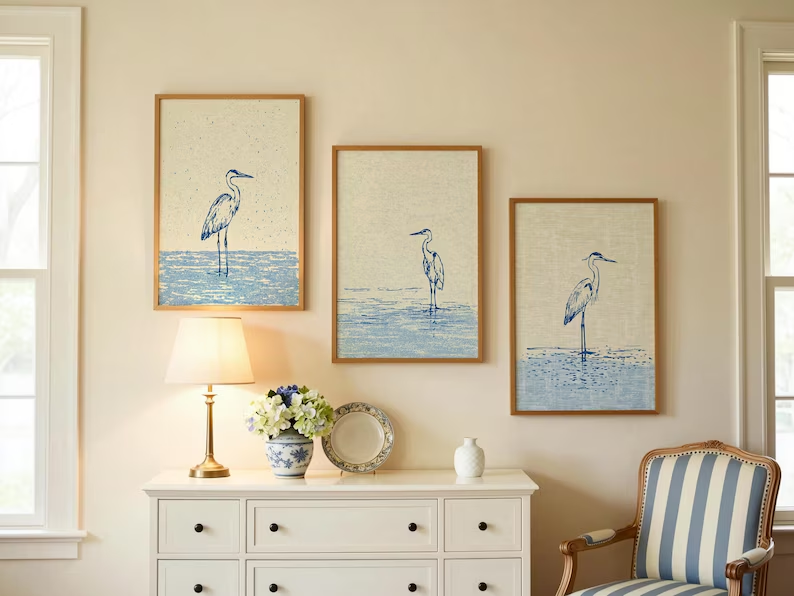
Bird art offered similar flexibility. Products could be optimized by bird species, room, décor style, emotional theme, and occasion. A cardinal print, for example, could target farmhouse, cottagecore, woodland, wildlife, and bird-lover searches, while coastal bird artwork could reach beach-house and nautical décor buyers.
We also found that many products had strong collection potential.
Instead of treating every design as one isolated listing, successful concepts could be expanded into:
- Individual prints
- Sets of two or three
- Different sizes and framing options
- Room-specific presentations
- Gift-focused variations
- Related collections
This approach allowed each creative concept to support a wider product family and generate several search-entry points.
Finally, the Creative department introduced more lifestyle-focused presentations. Golf artwork was displayed in offices, studies, club rooms, and traditional interiors, while bird artwork was shown in nurseries, bedrooms, farmhouse, cottage, and coastal spaces.
The objective was not only to make the listings more attractive, but to help buyers immediately imagine the artwork in their own homes.
The Strategy - Combining SEO and Creative Execution
Based on the audit, we built a coordinated strategy across four key areas: keyword targeting, product development, listing structure, and visual conversion.
1) Niche-Specific SEO Structure
We created separate keyword maps for the shop’s priority categories instead of using the same broad wall-art terms across the entire catalog.
Each listing was positioned by:
- Product subject
- Décor style
- Room placement
- Gift recipient
- Occasion
- Product format
- Buyer intent
Golf products were optimized around specific courses, golfer gifts, offices, man caves, and print sets.
Bird products were structured around species, cottagecore, farmhouse, nursery, coastal décor, and nature-inspired gifting.
This gave every listing a clearer role and reduced internal keyword overlap.
2) Search-Trends Product Development
SEO research was used before new products were created.
The SEO and Creative teams worked together to identify:
- Niches with strong buyer demand
- Products with collection potential
- Gift-focused opportunities
- Designs suitable for both single prints and sets
- Categories where the shop’s visual style could stand out
This approach helped CuriousCanvasCorner enter the Golf Art and Bird Art niches with products built around real search behavior.

3) Single Prints and Sets
We expanded successful concepts into both individual listings and multi-print sets.
Single prints offered a lower entry price and targeted specific subjects.
Sets created:
- Higher order-value potential
- Stronger gallery-wall positioning
- More impactful thumbnails
- Additional keyword opportunities
- A complete decorating solution
For example, famous golf-course designs could be sold individually or as coordinated three-print collections.
4) Conversion rate based SEO Optimization
Titles, tags, categories, and attributes were rebuilt around multiple layers of buyer intent.
Listings targeted combinations such as:
- Subject + product
- Room + décor
- Recipient + gift
- Occasion + gift
- Location + artwork
- Format + collection
This expanded visibility beyond broad terms such as “golf wall art” and helped listings rank for more specific, high-intent searches.
5) Stronger Visual Appeal
The Creative department redesigned the listing presentation to support the targeted keywords and buyer journey.
The focus was on:
- Clearer hero images
- Realistic room mockups
- Stronger set presentation
Golf artwork was presented in offices, studies, and club-style interiors, while bird artwork was shown in nurseries, cottages, farmhouses, and coastal spaces.
This helped customers understand the product and imagine it in their own homes.

The Breakthrough
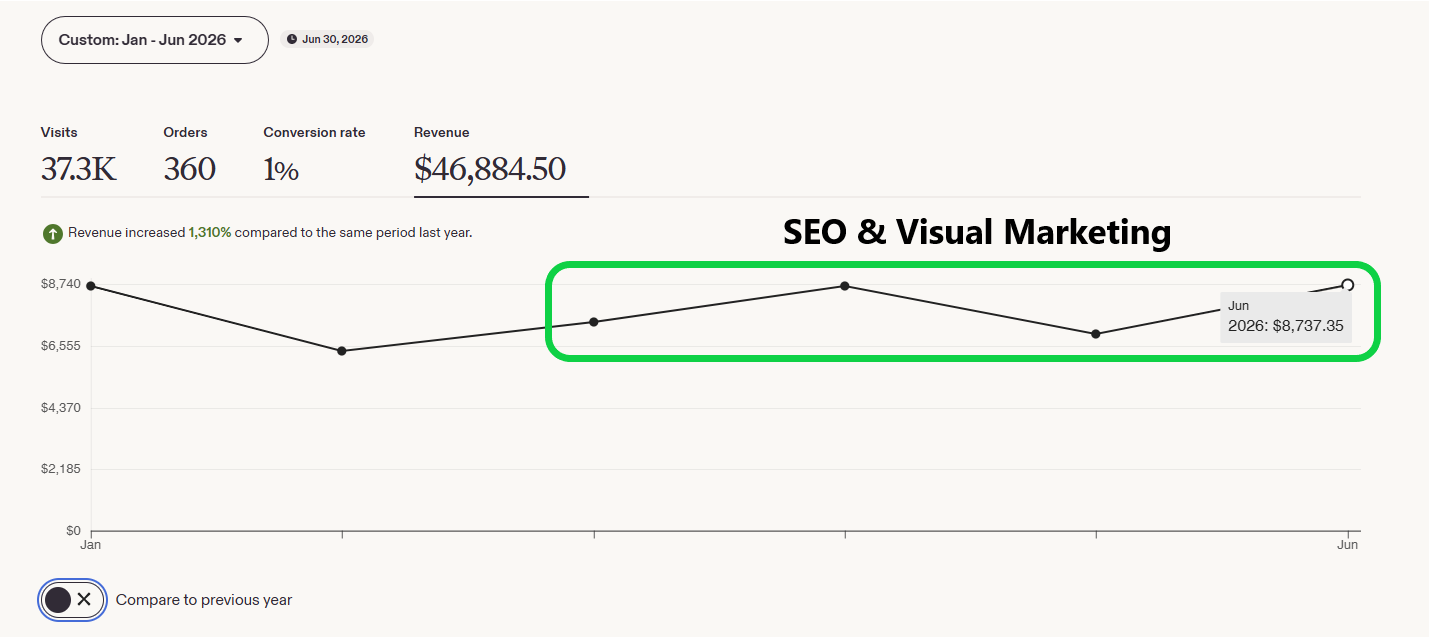
Within 3 months of joining both the SEO Success Program and the Visual Marketing package, CuriousCanvasCorner achieved its highest monthly revenue of 2026, a record-breaking $2,256 revenue day, and its highest conversion rate of the year at 1.24%.

The growth came from a combination of:
- Expansion into new niches
- Stronger keyword targeting
- Better product differentiation
- Improved single-print and set listings
- More effective listing visuals
- Closer alignment between SEO and buyer intent
The SEO team identified the strongest search opportunities, while the Creative department turned those insights into new products, coordinated collections, and more compelling listing images.
Together, this created products that were easier to discover, more attractive to click, and more likely to convert.

